

If this publication is called The RevOps Roadmap, it makes sense to start with a simple question.
TLDR Key Takeaways
1. RevOps is the function responsible for improving the company’s revenue engine across the full customer lifecycle.
2. It sits at the intersection of process, technology, and data.
3. Its purpose is to reduce friction between marketing, sales, customer success, and finance.
4. Without RevOps, teams often become siloed and optimize for their own metrics instead of shared revenue outcomes.
5. In practice, RevOps can look different by industry, but its core role stays the same: to make revenue generation more efficient, consistent, and measurable.
What exactly is RevOps?
The term gets used often, but not always consistently. In some companies, RevOps means sales operations with a new label. In others, it means a reporting team, a systems team, or the group that owns the CRM. Those pieces can all sit inside RevOps, but none of them fully define it.
At its core, RevOps is the function responsible for architecting & engineerig the company’s revenue generation engine so that it works as a fine-tuned system.
That definition matters because revenue is not just another business metric. It is the output that keeps the business running. Revenue funds hiring, product development, customer support, expansion, and long-term strategy. When revenue is healthy and predictable, a company has options. When it is inconsistent, even strong teams feel the pressure.
That is why RevOps matters.
RevOps is the owner of how the go-to-market machine runs. It is judged by the performance of that machine over time, how efficiently it creates pipeline, converts demand, supports customers, expands accounts, and contributes to durable revenue growth.
It does not close every deal. It does not run every campaign. It does not manage every customer relationship.
But it helps design the environment where those activities can happen well, consistently, and at scale.
The Business Flow Behind Revenue
To understand RevOps, it helps to look at the basic structure of how a business turns value into revenue.
A simplified version looks like this:
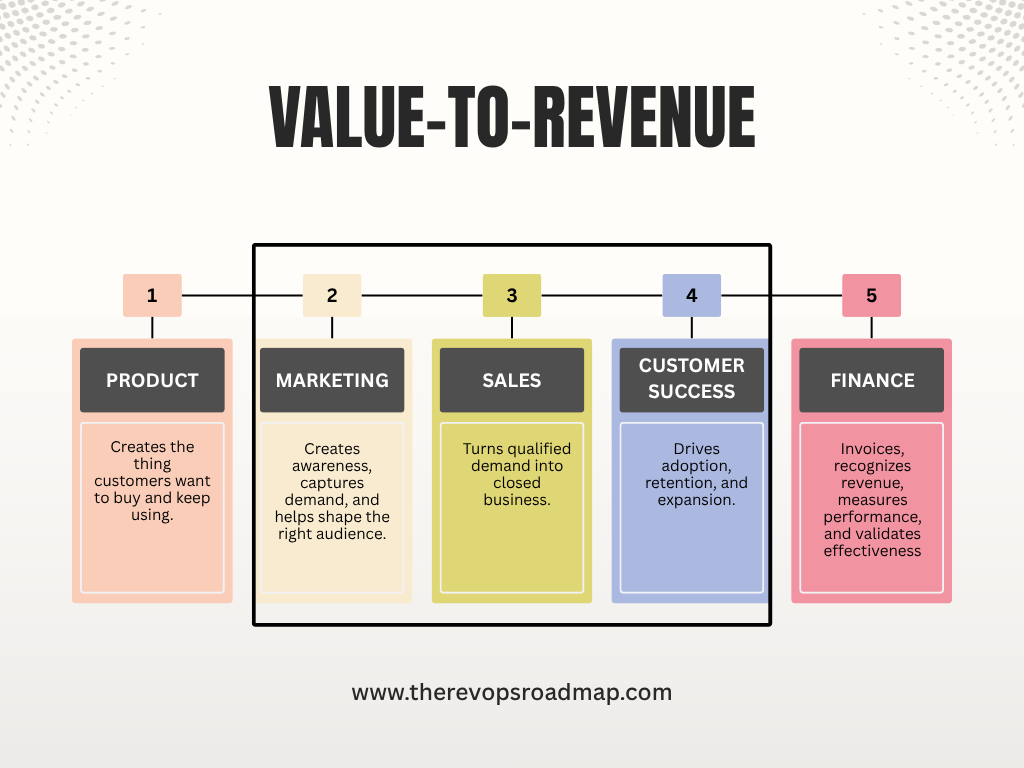
Each team plays a different role.
1. Product creates the thing customers want to buy and keep using.
2. Marketing creates awareness, captures demand, and helps shape the right audience.
3. Sales turns qualified demand into closed business.
4. Customer Success drives adoption, retention, and expansion.
5. Finance invoices, recognizes revenue, measures performance, and helps the company understand what is actually working.
Inside that broader flow, companies often use the term Go-to-Market, or GTM, to describe the customer-facing revenue teams.
In most cases, GTM includes:
1. Marketing
2. Sales
3. Customer Success
These teams are tightly connected, whether they admit it or not.
Marketing influences lead quality and volume. Sales influences conversion and deal structure. Customer Success influences retention, expansion, and net revenue retention. Finance closes the loop by validating what turned into real revenue and how that revenue performs over time.
If one part of the system breaks, the whole revenue engine feels it.
That is the lens RevOps brings.
Instead of asking, “How is each team doing on its own?” RevOps asks, “How well does the full system move a prospect from first touch to retained customer and expanded account?”
What Happens Without RevOps
Many companies operate for a long time without a true RevOps function. Some do fine for a while, especially early on. Small teams can compensate with hustle, direct communication, and tribal knowledge.
But as a company grows, cracks begin to show.
The biggest problems usually fall into two buckets.
Teams become siloed
Marketing, sales, and customer success often work toward related goals, but through different tools, processes, and incentives.
Marketing may be measured on lead volume.
Sales may be measured on closed revenue.
Customer Success may be measured on retention or renewals.
None of those goals is wrong. The problem is that each team can start optimizing for its own metric without enough feedback from the others.
That creates questions like:
Is Marketing generating leads that sales can actually close?
Is Sales setting the right expectations for onboarding and retention?
Is customer feedback making its way back into targeting, messaging, and qualification?
Does Finance trust the data being used in forecasts and board reporting?
Without a function explicitly responsible for alignment, these issues often linger longer than they should.
Teams optimize for themselves, not for the flow
This is the deeper issue.
When there is no RevOps lens, each function tends to improve its own part of the process rather than the end-to-end customer journey.
Marketing might add more form fields to hit a target, even if lead quality drops.
Sales might build workarounds in the CRM to move faster, even if reporting becomes unreliable.
Customer Success might create manual handoff processes because implementation data is incomplete.
Finance might spend weeks reconciling bookings, billings, and actual revenue because upstream systems are inconsistent.
Every team is trying to solve a real problem.
But the combined effect is friction.
Handoffs get messy. Definitions drift. Data quality degrades. Forecasting becomes political. Customer experience suffers. Leadership loses confidence in the numbers.
Eventually, growth slows, not because the market disappeared, but because the revenue engine cannot run cleanly at scale.
What RevOps Focuses On
RevOps exists to reduce that friction.
Its job is not to replace the expertise of marketing, sales, or customer success. Its job is to make those teams more effective by improving the underlying process, technology, and data that connect them.
That focus usually shows up in three core areas.
1. Process
RevOps designs and improves how work moves across the revenue lifecycle.
That includes things like:
Lead routing and response workflows
Qualification criteria
Lifecycle stages
Handoffs from marketing to sales
Handoffs from sales to onboarding or customer success
Renewal and expansion workflows
Forecasting and pipeline review processes
Good RevOps asks practical questions.
Where does work get stuck?
Where do leads get lost?
Which approvals slow down deals?
Which handoffs rely on Slack messages and memory instead of a clear process?
When the process is well designed, teams spend less time chasing internal confusion and more time creating customer value.
2. Technology
RevOps often owns or influences the systems that support the revenue engine.
That may include:
Customer relationship management, or CRM, platforms
Marketing automation platforms
Routing tools
Enrichment vendors
Sales engagement tools
Customer success platforms
CPQ, or configure, price, quote systems
Billing or subscription tools
Dashboards and business intelligence tools
The goal is not to buy more software.
The goal is to make sure the tech stack supports the actual operating model of the business.
Bad systems architecture creates duplicate work, poor adoption, and unreliable reporting. Good systems architecture makes the right action easier, faster, and more consistent.
3. Data
RevOps is also responsible for helping the business trust its revenue data.
That means creating shared definitions and making sure the data model supports decisions.
Examples include:
What counts as a qualified lead?
What is the source of truth for pipeline?
How are accounts, contacts, opportunities, subscriptions, and renewals connected?
Which fields are required at each stage?
What is the difference between booked revenue and recognized revenue?
When data is messy, every downstream decision gets harder. Leaders argue about whose dashboard is right. Teams spend hours cleaning spreadsheets before meetings. Forecasts lose credibility.
When data is clean enough and governed well enough, teams can move faster with more confidence.
That is one of the highest-leverage outcomes RevOps can produce.
The Real Goal: Help GTM Teams Focus on Their Job
A useful way to think about RevOps is this:
RevOps works on the revenue machine so that GTM teams can work within it.
Marketing should be focused on message, audience, campaigns, and demand creation.
Sales should be focused on discovery, solution fit, deal execution, and customer trust.
Customer Success should be focused on adoption, outcomes, retention, and expansion.
If those teams are spending too much time fixing routing logic, debating field definitions, chasing broken handoffs, or rebuilding reports manually, the system is not supporting them well.
RevOps steps in to improve the machine behind the scenes.
When it works, the result is not just more efficiency. It is more revenue, because fewer opportunities are lost to internal friction.
That does not mean RevOps magically creates growth. Market demand still matters. Product quality still matters. Leadership still matters.
But RevOps increases the odds that the company can convert its effort into revenue with less waste.
What RevOps Looks Like in Reality
The exact shape of RevOps depends on the business model, industry, growth stage, and complexity of the customer journey.
Here are a few simplified examples.
SaaS company
A software as a service, or SaaS, company might generate inbound leads from content, paid search, product signups, and outbound prospecting.
In that environment, RevOps may own or support:
1. Lead scoring and routing rules
2. CRM lifecycle design
3. Sales territory logic
4. Pipeline stage definitions
5. Forecast rollups
6. Customer onboarding handoffs
7. Renewal visibility and expansion reporting
If the business sells subscriptions, RevOps may also partner closely with finance on bookings, churn, annual recurring revenue, or ARR, and net revenue retention, or NRR.
The core challenge is often aligning fast growth with accurate process and reporting.
Manufacturing or industrial business
In a manufacturing environment, the sales cycle may be longer, the buying committee may be larger, and quoting may be more complex.
Here, RevOps might focus on:
1. Quote workflows and approval processes
2. CRM and enterprise resource planning, or ERP, integration
3. Account hierarchy and territory assignment
4. Channel partner attribution
5. Pipeline health reporting across long sales cycles
6. Handoffs from sales to fulfillment and finance
The challenge is less about high-volume lead flow and more about operational consistency across complex deals.
Professional services firm
In a services business, revenue depends heavily on how opportunities are scoped, sold, staffed, and retained.
RevOps may help with:
1. Lead intake and qualification
2. Opportunity stages tied to service lines
3. Proposal workflows
4. Forecasting based on project start dates and capacity
5. Client expansion tracking
6. Feedback loops between delivery, account management, and finance
In this model, RevOps helps the firm connect pipeline quality with delivery reality. Selling work that the team cannot profitably fulfill creates revenue problems later.
E-commerce or retail brand
An e-commerce brand may not use the RevOps label as often, but the need still exists.
RevOps-type work can include:
1. Customer acquisition funnel tracking
2. Attribution logic across channels
3. Lifecycle marketing systems
4. Conversion reporting
5. Subscription retention analysis, where relevant
6. Customer support feedback loops into marketing and product
The systems and terminology may differ, but the need to align process, data, and tooling across the customer lifecycle is the same.
Common Misunderstandings About RevOps
A few misconceptions are worth clearing up.
RevOps is not just sales ops with a rebrand
Sales operations may sit inside RevOps, but RevOps should cover the broader revenue system.
If the function only optimizes for sellers and ignores dependencies on marketing, customer success, and finance, it is not operating within a full RevOps model.
RevOps is not only about tools
A company can buy an expensive stack and still have poor RevOps.
Tools matter, but a bad process implemented in software is still a bad process, just faster and with the potential to have a larger impact due to scale.
RevOps is not purely reporting
Reporting is part of the job, but dashboards are outputs, not the mission.
The mission is to improve how revenue is generated and retained.
A Practical Definition
If you need a plain-English definition, use this:
Revenue Operations is the function that aligns process, systems, and data across marketing, sales, customer success, and finance to help the business generate revenue more efficiently and predictably.
That definition is broad enough to apply across industries, but specific enough to be useful.
It also points to something important.
RevOps is not just administrative support. Done well, it is an operating function with direct influence on growth.
Why RevOps Matters More Now
Modern go-to-market teams are dealing with more tools, more channels, more buyer complexity, and more pressure to prove efficiency.
That means the cost of poor coordination is higher than it used to be.
Leads can enter from dozens of sources. Sales cycles involve more stakeholders. Customer data lives in multiple systems. Renewal risk can show up long before finance sees it. Artificial intelligence, or AI, adds even more opportunity, but also more complexity if the underlying data and processes are weak.
In that environment, companies need more than talented teams.
They need a way to make those teams operate as one revenue system.
That is the job of RevOps.
HODL T.
What Next?
If you are new to RevOps, this is the right place to start.
In future posts, we will go deeper into what RevOps teams actually own, how RevOps differs from traditional ops roles, what a strong RevOps tech stack looks like, and where AI can create real leverage without adding noise.
If that sounds useful, subscribe to The RevOps Roadmap.
The goal of this publication is simple: to help operators build better revenue systems with clearer thinking and more practical guidance.